


I’m doing a live event with Josh Schrei (host of The Emerald Podcast) in London on August 4th, exploring Land and Belonging through a mythic lens. Early bird tickets on sale now here - last year we sold out so book soon!
A Monday evening in Belfast. On a residential street, a black man kneels over a white man and raises a knife. He shouts, and stabs his victim in the neck and head until he’s overpowered by local men. Footage of the gruesome scene hits social media within hours.
By Tuesday 9th of June, shock and anger are coursing through the social body. Police eventually name the attacker as Hadi Alodid, a Sudanese refugee in his 30’s. The victim, who lost an eye and is in a serious condition, is a local man in his 40’s called Stephen Ogilvie.
I live in the centre of Belfast, and when I saw the horrific footage of Alodid’s attack, like many I knew an eruption was coming. On the nights of Tuesday 9th and Wednesday 10th of June, violent protests exploded onto the streets of North and East Belfast. Masked men burned homes suspected of housing immigrants. Others set up roadblocks to search cars for non-white passengers. It was brutal and indiscriminate.
The riots were met with horror by the majority of the population, and on Saturday 13th, an estimated three to five thousand people gathered in the city centre for an anti-racism rally, holding placards with signs like “Hate is the only threat to our streets” and “Belfast stands against racism.”
The past week in Belfast is a microcosm for rising tensions around immigration in many Western countries today. The north of Ireland has its own complex history around place and belonging, but this isn’t a piece about that. It’s about what the events in Belfast tell us about a global phenomenon I call ‘the Mythic Rebellion’.
It is an international, decentralised movement attempting to restore what it views as native European and American sovereignty by creating a new myth of what it means to be white, or culturally aligned to a nation. I’ve been researching it for the last three years, and explored it in detail in my pieces The Mythic Rebellion and Listen to the Land.
Living through its machinations, and paying attention to how its online tendrils breach into the streets, has given me a new perspective on how it can be stopped.
What is the Mythic Rebellion?
The Mythic Rebellion is, and isn’t, a resurgence of far-right nationalism. It is a rebellion in the sense that it is dedicated to fighting progressive elites and political technocrats who it believes have sold out their own people to foreigners, particularly Muslims. It rejects multiculturalism and adapts the identity politics of the progressive left into a new, darker form. It is influenced by what’s come to be called ‘the Woke Right’, a phenomenon I discussed with Helen Pluckrose on Kainos last year, but it is also more than that.
In previous pieces, I’ve argued that political movements like AfD in Germany, Reform in the UK and Rassemblement National in France can be viewed as expressions of the Mythic Rebellion. They are not its leaders. It has no leaders; it has rivalrous channellers who move in roughly the same direction.
It is not a traditional movement, but a collective “thoughtform” that arises from the shared beliefs, feelings, and intentions of different groups who reject globalisation, multiculturalism, Wokeness and Islam.
There is a name for this in occult literature: an egregore.
Once formed, an egregore is an entity that takes on a life of its own. It moves through and beyond the people who summoned it, becoming more powerful than any individual or group.
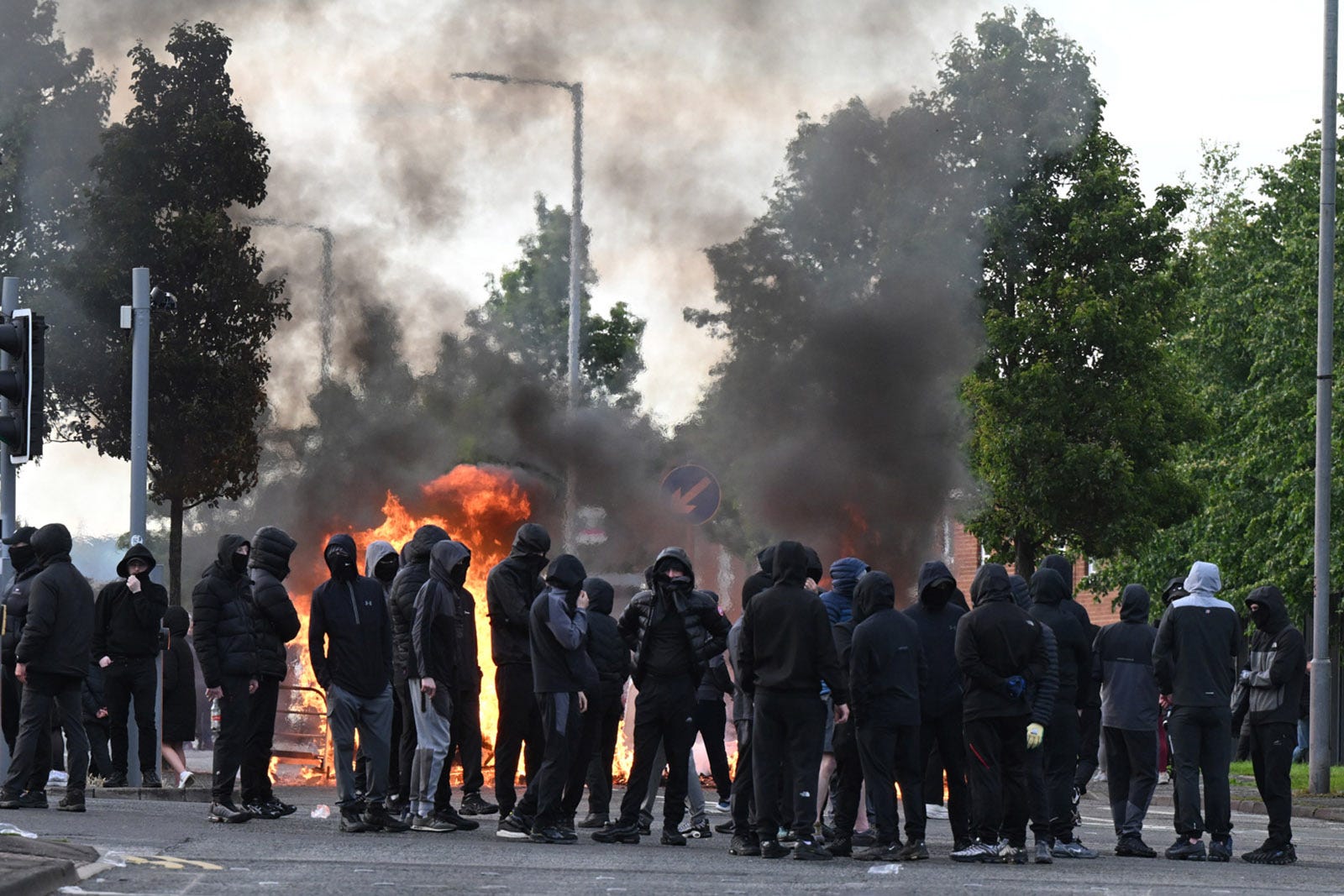
Setting aside its occult origins, the egregore is a useful analogy, because the Mythic Rebellion lives as much in the social imaginary as it does in the ballot box.
It takes many forms. It is a semi co-ordinated movement aimed at restoring white sovereignty. It is an expression of the shadow of progressive liberalism. It has tendrils in the Manosphere, and offers disenfranchised and directionless young men the opportunity to become a hero in defence of Western civilisation. It is also a voice for genuine concerns around the loss of cultural values and the impact of immigration on the social contract.
Simply calling this a far-right movement is misleading, as it doesn’t cast a wide enough net, and refers to the politics of a bygone era. It also ignores the many different paradoxes within this entity, for example the strange blend of Christian nationalism and nihilism of the Groypers in the US and its more secular flavour in the UK and Europe. It has fiercely nationalist tendencies, but an international sensibility. It appeals as much to angry working-class voters as it does to Randian tech-bros. It is obsessed with law and order, but calls for vigilante violence.
The rebellion is winning the narrative war in the West. It is winning, because it is providing an answer to an idea that its opponents, toothless technocratic governments and aimless progressives, don’t know how to approach in a new era.
“White identity should matter more than immigrant identity in Western nations.”
Most establishment politicians and the media have avoided serious engagement with this idea. It cuts right at the heart of progressive notions of power and identity. The concern is that even engaging with it opens the door to fascism, but in reality fascism arises when the provocation is ignored.
It is possible to transcend and include nativist ideologies with compassion, love and tolerance. It is also possible for multicultural societies to thrive in shared humanity. But for that to happen, progressivism has to evolve. It has to face the Mythic Rebellion and transform its darkness into light.
How the Egregore was Born
The first step in dealing with the Mythic Rebellion is acknowledging that some of its concerns are valid, but have turned ugly and twisted in the darkness of society’s basement.
The egregore is fuelled by the politics of betrayal. By people who feel that society’s elites have sold them out to foreigners. They’ve sent jobs overseas. Imposed years of austerity. Years of movies and TV shows lecturing them on social justice theory. Years of social consequences for any critique of multiculturalism. Years of being labelled as racist for asking why, if identity matters so much, white identity doesn’t also matter.
In the UK in particular, the rebellion has been fuelled by serious failings in immigration policy and effective integration of multiculturalism. It is simultaneously a valid concern about integration and security in multicultural societies, and a scapegoat mechanism.
The most potent example in the UK is what has become known as the ‘Grooming Gangs’ scandal.
For more than fifteen years starting in 1997, organised networks of predominantly male, British-Pakistani perpetrators sexually abused and exploited thousands of vulnerable, predominantly white, teenage girls in towns across England.
The Jay Report, published in 2014, exposed the scale of it in Rotherham: an estimated 1,400 children abused over sixteen years. It found that local authorities had been hesitant to investigate or aggressively pursue the predominantly Asian gangs for fear of being accused of racism or damaging community relations.
The scandal was only really taken seriously in the 2020’s, when sustained pressure built and a story once driven mainly by far-right commentators forced its way into the centre of national politics. A more recent report by Baroness Casey stated that “blindness, ignorance, prejudice, defensiveness and even good but misdirected intentions” all led to ethnicity data on the offenders being ignored or covered up.
For the Mythic Rebellion, the Grooming Gang scandal is used as one of many examples that the government cares more about multiculturalism, and Islam in particular, than its own native citizens.
Tension around immigration and security has only grown since. In 2024, a British-Rwandan teenager burst into a dance-class and killed three girls in their dance class and tried to murder ten more. The attacker, Axel Rudakubana, was neither an asylum seeker nor a muslim, but the attack sparked riots in Southport and throughout the UK.
In December 2025, a 23 year old British Sikh man, Vickrum Digwa, stabbed 18 year old Henry Nowak in Southampton. When police arrived at the scene, Digwa lied and told them he’d been racially assaulted. The officers handcuffed Nowak, the victim, who told them he couldn’t breathe and that he’d been stabbed; he died shortly after.
Less than two weeks before Alodid’s attack in Belfast, Digwa was sentenced to life and bodycam footage of that night was released. In the resulting protests and riots in Southampton, and the riots in Belfast, masked men chanted “I can’t breathe” at the police.
These incidents have fuelled the belief that, as Nigel Farage put it after the Southampton murder, “We’re living in a two-tier culture... where the rights and privileges of white people matter less than those of ethnic minorities.”
Progressive commentators often counter that the statistics don’t support the idea that minorities receive better treatment from police in the UK. They’re right. However, this egregore doesn’t feed on stats, it feeds on feelings.
Solat Chaudhry, head of the National Centre for Diversity and a former police officer, has recently argued that the real ‘two-tier policing’ centres around class, stating that “The working-class community has been dumped on for generations.”
As he points out, the grooming gang victims were also systematically ignored by police and social services because they were working-class.
This is a key facet of the Mythic Rebellion: class issues are reframed as racial issues, and legitimate class-grievances are scapegoated onto immigrants.
This economic and social context behind the mythic rebellion is important, and speaks to wider economic and social decline in many European countries and the US. These are real issues and it seems unlikely that any positive change will come in our current economic system. It explains the ‘rebellion’ aspect; a sense that the government has stopped caring about working-class people, which leads to a belief that vigilante justice is the only option.
But we’re dealing with something bigger, and deeper, than a political movement of nationalistic right wingers. This egregore taps into something much deeper in the collective psyche.
Tuesday Night
In the North of Ireland, the majority of rioters appear to have been working class and the most significant unrest was in traditionally Unionist, working-class areas. The political realities are far more complex than in England, but much of the language and imagery online the day of the first riots used the same language I’ve seen during other protests.
On Tuesday night, as the temperature increased, I spent hours on nativist and far-right X and Facebook accounts to try and make sense of what was going on. Again and again, the most popular memes and messages were those that called people to a greater calling. A mythic battle between light and dark.
It was disturbing and familiar. It was also uncanny: the egregore was adapting itself to Northern Irish politics. In one video, a Unionist reverend called for unity between Republican and Unionists to fight the scourge of immigration. Rumours were flying that anti-Immigrant groups from the Republic were travelling up to join Unionists in solidarity (there is no evidence this took place on any meaningful scale.)
Then, a post went viral announcing a mass protest and road closures, demanding that all businesses close by 5:30pm. Businesses was misspelled as ‘bunnesses’. It was not signed by any particular group, and the head of the PSNI (Police Service Northern Ireland) countered that there was no need for the shops to close.
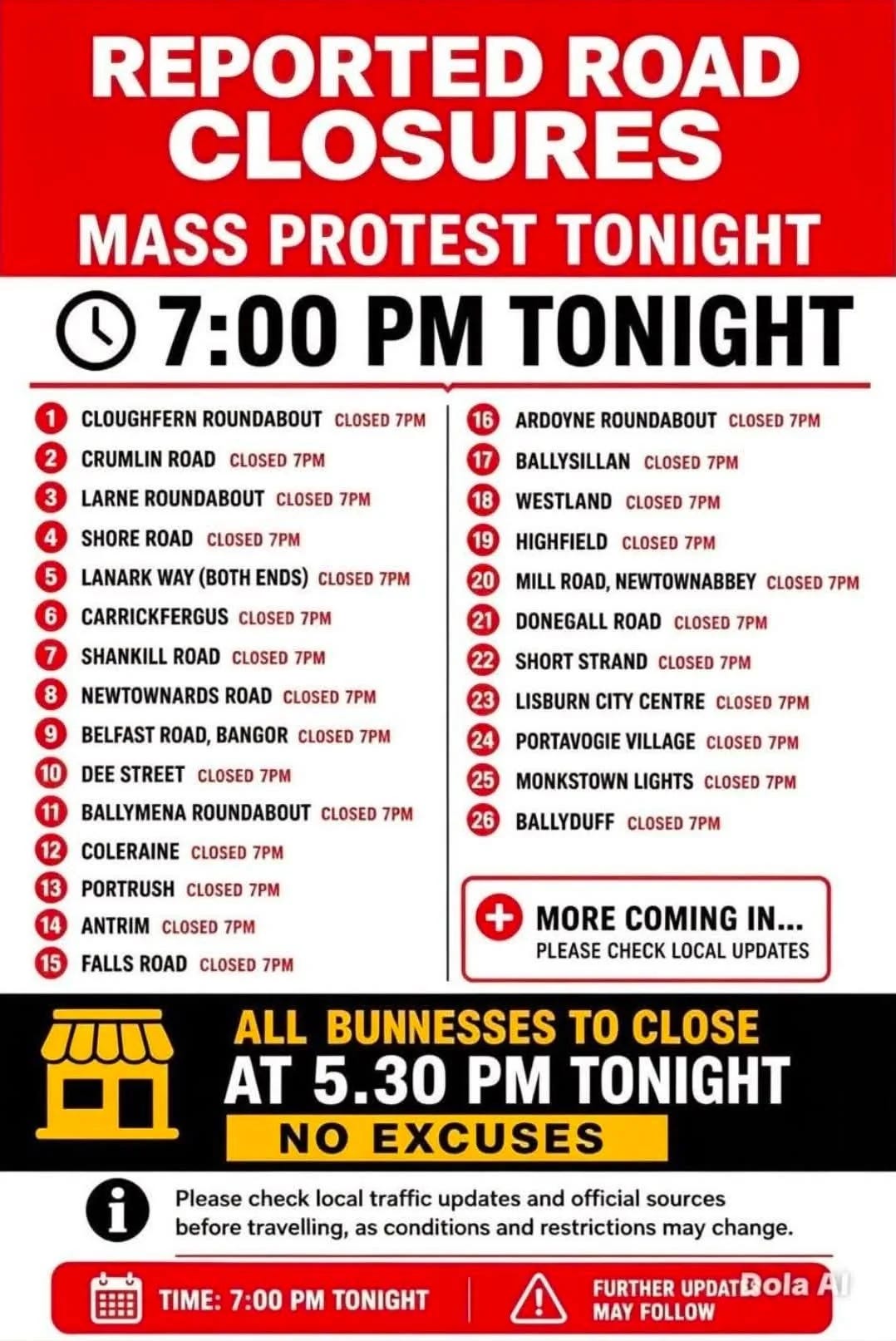
At around 6pm, I walked to the main shopping street in Belfast to see which message had won.
The shops were closed. Even KFC. Only a small Tesco was open. The security guard was a south Asian woman in her early 20’s. I felt concerned for her as I walked past.
When I got home, I went back online. People were shocked and angry about the attack. I was too. But while the attack was sickening and raised serious questions about the UK’s asylum policy, the responses were also dark. The main target was Islam, which many posters viewed as an existential threat.
It was clear in real-time that outside agitators were stoking the flames. Elon Musk and Tommy Robinson were particularly active, as were accounts, possibly bots, spreading misinformation. One viral X post claimed to show a riot already underway in North Belfast. The footage was months old (and since deleted), reposted from a fabricated TikTok account: a ‘broken windows’ tactic, designed to get people onto the streets by making it look like the protest had already begun.
Some memes called for young men to hit the streets wearing black. Others showed AI generated Crusade imagery with evocative music, exhorting young men to defend the land. An image of Alodid wielding his knife over a helpless Ogilvie with the words ‘Enough is Enough’ was everywhere.
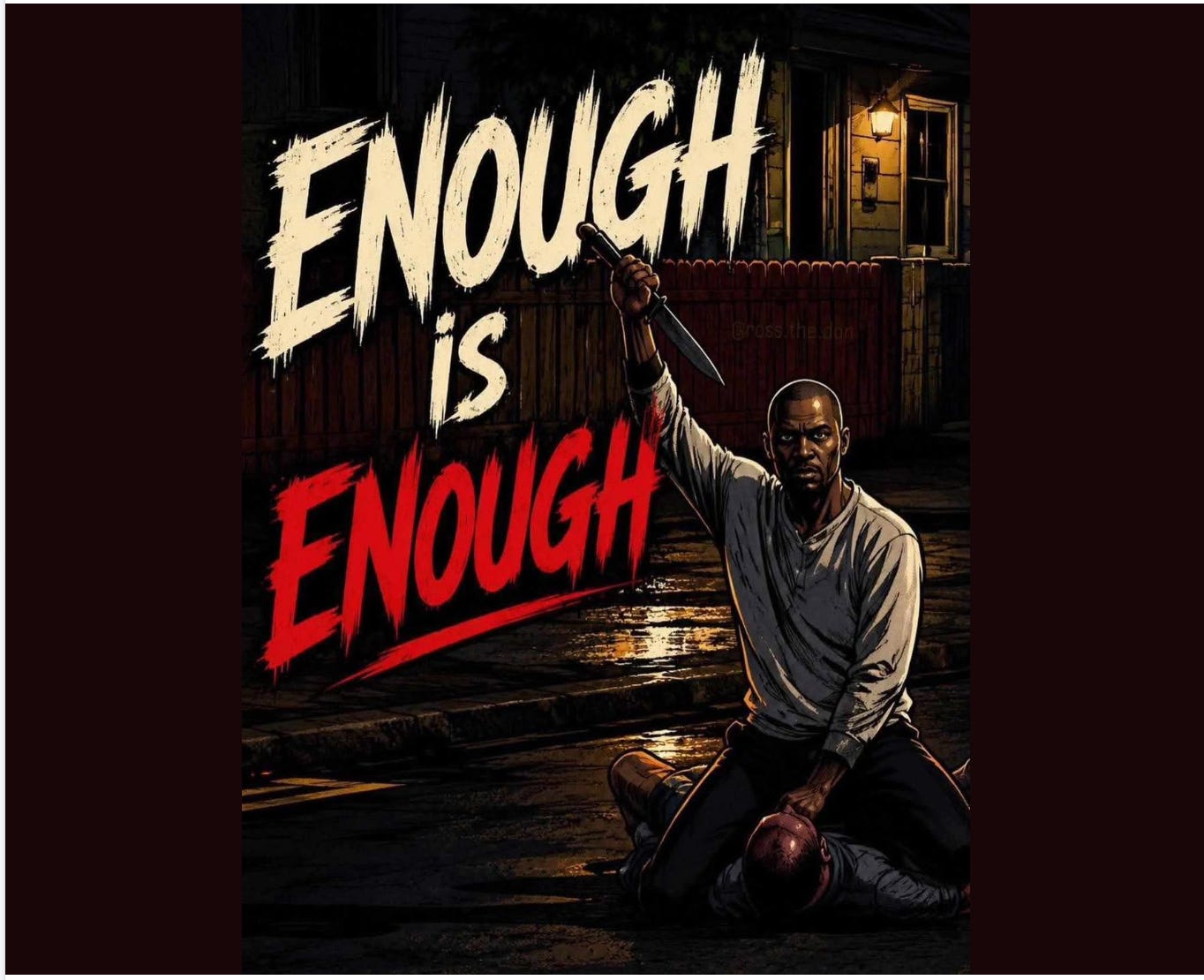
Many commenters were expressing unfiltered hatred. A few urged caution and the need for a peaceful protest. Others called openly for pogroms and indiscriminate violence against any and all immigrants.
It was hard to digest. As I’ve been working on this piece over the last week, I’ve realised how deeply sad I found it to see that level of hate resurface. In the seven months I’ve been back in Belfast, I’ve felt proud about how far the North has come since The Troubles. How different it feels since I was visiting family growing up, or living and working here while I was at University. I’ve also felt rage at grifters like Elon Musk and Tommy Robinson who stoked the flames but, as one local politician pointed out, wouldn’t be able to find Belfast on a map. Musk, who was so eager to end the ‘Woke Mind Virus’, has become the puppet for another mind virus.
Eventually, I closed my laptop and went to my window. I wondered just how big the planned protest would be. While I was contemplating this, it was already erupting a few miles away.
Masked men prowled the streets, setting fires, and indiscriminately bursting into homes and shops thought to house immigrants. Two Ugandan care workers, Sumayah Nakazibwe and Stella Ariokot, had to barricade themselves in their home while the houses around them burned and smoke seeped in. They described the assailants as ‘young boys between the ages of nine and 20’ who [don’t] know that the person they are targeting is actually looking after their mother or their granny.”
The Shadow
The disgusting and indiscriminate racism of the riots were met with widespread condemnation across Northern Irish society. Michelle O’Neill, the First Minister, described the disorder as “outright thuggery”, going on to say that “Groups of masked men burning families out of their homes is nothing less than disgusting cowardice.”
She’s right. And despite the almost universal derision, I have no doubt this is going to happen again. Not just in Belfast, but across Europe and the US. The Mythic Rebellion will keep growing, because there are no compelling counter-narratives coming from progressives.
Western progressivism is flaccid and ineffective, because it has not yet learned how to integrate its own shadows. It does not understand that to transcend our tribalism and closed mindedness, which we have to do, there is no choice but to go right into the depths of our darkest, most atavistic selves.
The shadow, in Jungian psychology, is a way of describing all the feelings and thoughts we reject and push away. Jung’s insight was that they don’t just disappear. Instead, they take on a life of their own and eventually, if they aren’t brought into awareness, they start to run the show from behind the scenes.
We find our shadows by following our contempt and disgust of the other, and then owning it as part of ourselves. When we do this, the shadow becomes what the author and lay therapist Ann Shulgin described as a devoted ally, one that takes its place alongside the conscious self but is never entirely tamed.
When we go through the process of seeing that all the darkness we project on to others actually lives within us, something profound takes place. All the life-force and energy we’ve used to keep it stuffed down in the basement is unlocked, releasing tremendous creative potential.

Cultures also have shadows. The Mythic Rebellion is an egregore created in part by progressives’ inability to integrate and transmute the tribalism and aggression inherent in all of us. Instead, as I argued in Pride of the Elites, progressive elites tend to sublimate their hunger for superiority and power into abstract notions of social justice that have very little to do with justice, and everything to do with elite status games.
This form of progressivism, which has been growing since at least the 1960’, pushes all the urges and perspectives it can’t tolerate into the margins, and it has to end. In fact, it already has, but most people haven’t caught up yet.
Tribalism, racism, bigotry. These are the cultural shadows that our institutions and progressive theorists tried so hard, and so understandably, to destroy after the second world war.
But shadows can’t be destroyed. In individuals, they birth alter-egos. In societies, they birth egregores.
Egregores only survive as long as they are fed. But every time Western politicians outsourced jobs in the name of corporate profit, or positioned the working classes as deplorable idiots, it grew. Every time a critique of multiculturalism was met with cries of ‘racist!’ it grew. Every time a critique of trans ideology was met with ‘transphobic!’, it grew.
With no way to be expressed and processed through the cultural body through ritual, real dialogue or cathartic revelation, our unexpressed psychic tension around race and class found its home on social media. Private WhatsApp groups. Hushed conversations at the pub. It grew and grew, fed by agitators like Musk and Robinson who want to profit from it, until it breached into the mainstream.
If we don’t deal with the Mythic Rebellion, what happened in Belfast is going to keep happening. Here and everywhere else. It could get much worse.
So how do you deal with an egregore?
Wednesday Afternoon
An Egregore can’t be scolded or attacked into submission. As the Czech occultist Franz Bardon suggests in Initiation into Hermetics, to overcome a force like an egregore, the psychic energy that feeds it has to be owned and transmuted by whoever created it. I would argue that this applies to the whole social body when it comes to the Mythic Rebellion. Both its originators and progressives need to come together to transform darkness to light. That does not just mean ‘talking about it.’ This is the middle-class, psycho-therapeutically influenced blanket solution to all issues, and it won’t work here.
Societies and governments across Europe talk about immigration constantly. It’s the main issue for every political party in Europe today, and there is no shortage of commentary or debate around it.
On Wednesday afternoon, after the first night of riots, I was driving and noticed the roads were unusually busy. I turned the radio on to BBC Ulster. The topic was, of course, immigration. The hosts were doing a good job of holding multiple perspectives. As I tuned in, a British-Asian contributor was pointing out how essential immigrants are to the Northern Irish economy, and how the vast majority of immigrants integrate well.
I thought ‘She’s right, and she’s missing the point.” Her arguments aren’t wrong, but they also aren’t going to land outside of the audience who already believe them. What progressives should be speaking to isn’t a question at all.
It’s a feeling. A feeling of status, belonging, and pride. These are embodied feelings, both individually and socially, and have to be met at the level of the individual and social body.
To make matters worse, the wholesale import of American identity politics into European progressive thought means that feeling pride or belonging in white identity is seen as the root of evil, tribalism, division. It can’t even be felt or discussed. But it is the idea that some feelings can’t be felt that creates cultural shadows.
That night, there was another night of riots across the region. In Newtownabbey, police deployed water cannons to disperse the crowds. At least 16 people were arrested, and twelve officers were injured, some by Molotov cocktails.
On Saturday, a pro-immigration rally took place in the city centre. I was happy to see it, but just as I felt the radio contributor was missing the point, I felt a sinking feeling noticing it was working on an old progressive script that sees the key argument as whether immigration is good or bad.
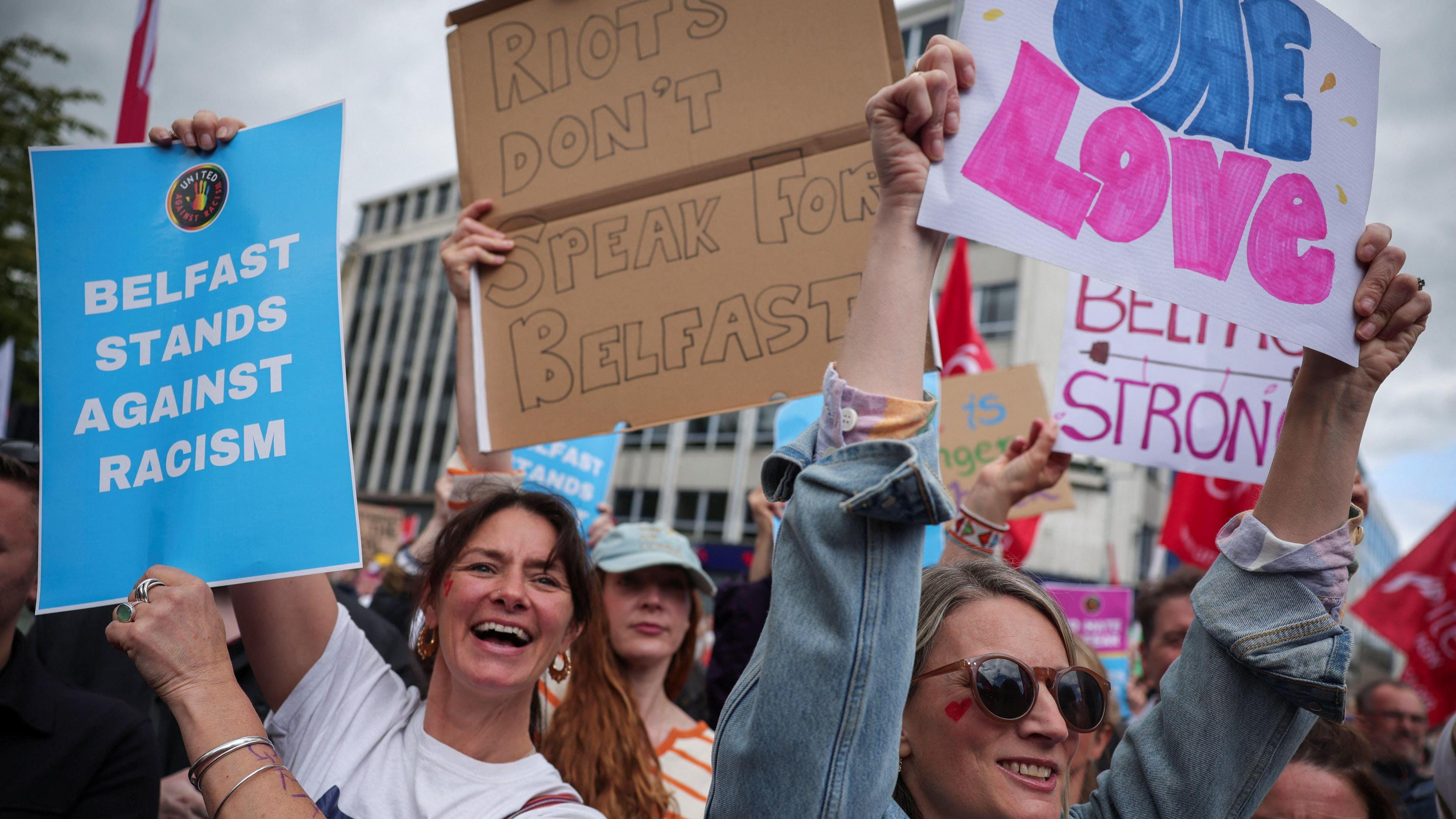
Speaking at the rally, Amnesty International’s Northern Ireland director Patrick Corrigan said that the issue was not immigration but racism, and that the solution was for the government to combat misinformation and create a better ‘Racial Equality Strategy’.
This old script is not going to work. The label ‘racist’ has been used to shut down meaningful debate for so long that it’s become a badge of honor for many on the right.
The low-impact messaging from organisations like Amnesty International are a textbook example of why progressivism is losing the narrative war. The progressive response can’t just be ‘immigrants are welcome’ or ‘racism is bad’ because it misses one of the key driving narratives of the egregore: that Western elites and progressives have chosen foreigners over their own people. Many on the right view ‘immigration isn’t an issue’ as a gaslighting by an intellectual elite who are detached from reality.
This is where the Mythic Rebellion has the most signal. For years, progressive politics in the West has been stuck in an impossible contradiction: it holds that liberal values like universal human rights, women’s rights and LGBTQ rights are paramount, while also insisting that all cultures are equal.
This is not a coherent position. It suggests that female genital mutilation is equally valid to universal human rights. In its terror of hierarchy, progressives forgot that to transcend hierarchy, you have to first acknowledge it. The simplest way to do this is, as philosopher Terence McKenna pointed out, to realise that ‘culture is not your friend’.
Culture is an operating system. A culture’s traditions, ideals and rituals can give us ideals that lead to greater human freedom, co-operation and flourishing, or it can be regressive and stifling.
For a multicultural society to thrive, we have to transcend culture itself. To move beyond the regressive identity politics of the left and the right, and see one another as human beings first, and people carrying a cultural meme second.
Progressives, captured by imported American identity politics and a deep cultural narcissism, have failed to do this. The result is that nobody has been able to say, as the memes so clearly expressed, ‘enough is enough’ for so long that now it is the truly regressive, racist, power-hungry assholes on the right saying it.
They are winning, because the average voter can feel the truth in what they’re saying: Western society has become too tolerant, and too weak to stand up for its own values.
Twisted Masculinity
For everything the Mythic Rebellion gets right, it gets a lot more wrong. While it may accurately point to a significant progressive failing, its interpretation as to why this situation has arisen is more the result of projection than real understanding.
It draws deeply on a thread that’s been running through the political Right for years: society has become too feminine. Too soft, too empathetic, and too naive to understand the threat posed by regressive cultures.
This notion is captured in the idea of ‘The Longhouse’ that started gaining traction among right-leaning intellectuals in the early 2020s. As conservative writer Jonathan Keeperman puts it, “ the Longhouse refers to the remarkable overcorrection of the last two generations toward social norms centering feminine needs and feminine methods for controlling, directing, and modeling behavior.” The Longhouse is ruled by the ‘Den Mother’; a devouring feminine entity that suffocates through care.
One of the most prevalent ideas I saw trawling social media on the first night of the riots was that men in Northern Ireland had a duty to protect their women.
An 18 year old woman from Belfast, Katie Gormley, went viral on TikTok in the aftermath of the riots condemning this narrative. She points out that, “The North has one of the highest per capita femicide rates in the UK and Europe.” and that “The overwhelming majority of these murders were committed by men known to the victims, so partners, family members, husbands.” She goes on to say that if she’d been killed the night before, none of the men rioting “would even so much as lay a flower on my grave.”
Gormley is pointing to something important, in fact vital in dealing with the Mythic Rebellion: it is a masculine egregore. That doesn’t mean it doesn’t also appeal to women, or that women don’t have concerns about immigration or cultural identity.
What it means is that it is fueled by the concerns of men, in particular the shame and deficiency of low-status, directionless or frustrated men. There is a real economic aspect to this: Oxford University’s Migration Observatory points out that men over 18 account for the majority (76%) of all asylum arrivals on small boats to the UK. Usually unskilled, they represent direct wage competition to young working class men.
The sociological literature is divided on whether it is a loss of status, or a loss of economic opportunity, that is driving so many men to extreme political views. It is likely both. What the literature agrees on more is that these factors create the potential for radicalisation, they don’t radicalise in and of themselves. They leave young men open to manipulation from trillionaires and grifters who want to use them to increase their own power.
The Mythic Rebellion is not just a masculine egregore; it’s a castrated masculine egregore. A mature man takes responsibility for building a better world, he doesn’t childishly displace his grievances on innocent people. This is an egregore powered by deficiency and insecurity disguised as bravado. It is, at its heart, pathetic and weak.
Integration
At its heart, the Mythic Rebellion is a twisted yearning for belonging and connection. It can’t be lectured or reasoned into submission. It has to be fully accepted and transmuted by the cultural body in the West.
That means listening to its concerns, while still condemning the way it voices them. It means upholding liberal ideals of human equality, freedom and compassion in a multicultural society while also knowing when to say ‘enough is enough’.
There is no other way than for progressivism to re-integrate the masculine values it has pushed into the shadows. Not a castrated, deficient masculinity that tries to bully its way to feeling strong, but a masculinity that can say ‘enough is enough’ without projecting its own deficiencies. One that can reject the toxic empathy and sneering contempt of the political elite without collapsing into misogyny and victimhood.
Appeals to tolerance will only fuel this egregore; an excess of tolerance is central to the myth it is based on. What we need instead is a new progressive mythos that understands the difference between boundaries and intolerance: one that can align to a hierarchy of cultural values without marginalising those who are different, and is mature enough to speak the language of belonging, status, grievance and tribalism while also transcending it.
To be truly progressive, we have to own our inherent closed mindedness as well as our highest visions for collective unity. To transcend tribalism, we have to embrace tribalism. To defeat an egregore, you have to become it: to integrate back into the social body which has ignored, marginalised, and made wrong its own deeper urges.
It can be done. Greater unity and deeper complexity is more enticing, and more exciting, than division and hate. That unity can only come about by properly integrating our collective shadows.
Can’t help thinking about Houellebecq’s Submission. It was visionary and refuted rather than leading to debate. I still have a very uneasy feeling thinking about that book and -as a woman, its author - but I believe in all its irony and dark cynicism it is a very very smart book. For those who don’t know, I really recommend reading it. It is about what happens when tolerance becomes too big. And it makes me think that in terms of transformation this is the passage from green to teal societal structures (Ken Wilber). And yes that means that all previous colours (also green) need to be integrated and transcended. How to practically do that in the discourse is very very complex. For me the real question is how in the public discourse you put out complex humane messages next to very simplistic sloganesque ones. How to talk towards our common humanity. Maybe by addressing the needs underneath it. And then it is not only about talk and discourse but about actions. How are needs being met in a society that will know more contraction in the phase of transition (Bruno Latour, where to land). HE proposes already the new dichotomy between open and closed. How will we protect boundaries when resources become scarce (due to climate heating), who do we let in/under what conditions. The new frontier between political parties is the frontier between how open and closed you want to be. All necessary literature now I feel to fuel this debate …
This is one of the most powerful and insightful analyses I've read of our current predicament. I won't comment further at this stage because I want to weigh it (and the comments of others) thoughtfully and give it the credit it deserves. However, one line jumped out at me, the one about people having had enough of movies preaching at them about social relations.
I find this particularly topical in a week when the two great franchises of boomer optimism, Star Trek and Doctor Who, are put on a hiatus that may well become permanent, and when the latest Spielberg and Toy Story 5 have received a lukewarm critical reception.
We desperately need new stories, or perhaps to return o the old ones. Say what you like about Star Wars, and I never cared for it much myself, it was a lot more savvy about confronting and integrating the Shadow.