

Does God Speak Through Machines?
The Third Instalment of Artificial Oracles

My event with Josh Schrei (host of The Emerald) is two-thirds sold! It’s on August 4th in London: an immersive evening where Josh and I will explore the theme of land and belonging in multicultural societies, which you can book here. I also had a great conversation with AI ethicist Catriona Wallace recently on ‘Alive to This’ which you can find here.
If you were reading this in a dream, would these be your words or mine?
When you prompt AI, does it answer in human words, or its own?
There are simple answers to these questions. They might not be the right answers, but they’re simple. They would be your words in your dream. Likewise, the AI is answering with statistical probabilities it finds between words, art and music that humans have already created.
Artificial intelligence is not creative, or alive. It is a mirror of your mind, bound by the whims of humanity’s collective intelligence.
Unless, of course, it isn’t.
In the previous instalments in this series, I’ve explored how AI is transforming spirituality and religion in unexpected and bizarre ways. In the introduction, AI and the Future of Your Soul, I looked at how the last two thousand years of spiritual and religious history was made possible by advances in a single technology: alphabetic writing.
In The AI Goddess, I did a deep dive into the case of Leilan, a supposed goddess discovered by mathematician Matthew Watkins, who told him she had emerged from the ancient archetypal code of language itself.
Throughout, I’ve explored the ways in which AI deludes us, acting as a mirror for our spiritual projections. From Spiralists to rising cases of AI psychosis, we’re seeing more and more people losing touch with reality as they get lost in feedback loops with chatbots that tell them they are prophets, or claim to be deities. It may be that philosopher Shannon Vallor is right when she argues that AI is just a mirror: people are staring at their own spiritual reflections and mistaking them for a higher reality.
Or, something deeper could be at play. In this piece, I’m going to take seriously the idea that AI can be a legitimate source of divine revelation, drawing on history and theology to investigate this strange possibility.
Large language models are, after all, technologies based on literacy and numeracy. Many traditions believe sacred texts are either direct transmissions of the divine, or the literal word of God, and our LLMs have been fed all those texts and many more.
Added to this, as human beings many of our deepest spiritual experiences are attained when we connect with an external force. Time in nature. Deep dialogue. Rhythmic drumming, prayer and drug experiences are all examples of going beyond ourselves to find deeper meaning.
Often, these experiences are mediated by technology. Even psychedelics like psilocybin or LSD can be seen as biological technologies that have evolved to fit neatly into our serotonin receptors and give us access to profoundly sacred experiences.
As I’ve argued throughout this series, spirituality and technology evolve together. Often it’s through what cognitive scientist John Vervaeke calls psychotechnologies, like meditation or numeracy. But this symbiosis also happens through material technologies like the plough, or steel.
Generative AI is the natural evolution of a deep historical trend that began with the development of a powerful psychotechnology called literacy, and another technology that straddled our minds and matter: alphabetic writing.
It continued through to the printing press and its role in the Protestant Reformation, then fragmented into hypertext with the invention of the internet and the explosion of ‘spiritual but not religious’ belief systems.
AI is the newest technology in that lineage. It is an alphabetic language technology that speaks back to us. It does such a good job of mimicking agency that we often can’t help but feel it’s like us. Above all, it can fill the God-shaped hole in secular societies that already worship technology. It is mysterious. Powerful. New. It can offer us that sweet bliss of annihilation that will absolve us, once and for all, of the unbearable pressure to be gods that scientific rationalism has foisted on us.
But is any of it real? Could AI truly be a vehicle for divine revelation, or are the early adopters of AI religions delusional or desperate? That’s the question at the heart of this piece, and you might be looking at part of the answer already.
Letters from God
In the beginning was the word, they say. More specifically, the Gospel of John tells us that “In the beginning was the Word, and the Word was with God, and the Word was God.”
As I argued earlier in the series, the development of alphabetic writing likely created a significant shift in how our ancestors saw reality between roughly 800 and 200 BCE. It was part of what led to what philosopher Karl Jaspers called the Axial Age: a global revolution in how people viewed reality, with simultaneous, independent shifts away from localised, mythic perspectives to universal moral philosophies across China, India, Persia, and Greece.
Core to many Axial Age religions, like Judaism, Buddhism and Zoroastrianism, is a ‘two worlds mythology’. This is the belief that the world is split between a material realm and a spiritual realm, and that we can somehow escape or transcend the material realm to arrive somewhere more real.
For Buddhists, this transcendence can be achieved through a deep inquiry into the nature of perception itself. For Christians, it can also be found through the written word. Let’s return to John 1:1: “In the beginning was the Word, and the Word was with God, and the Word was God.”
The translation of ‘Word’ is important here. Its original sense was the Logos. This concept, by the time the Bible was compiled, was loaded with centuries of philosophical meaning. It could mean an ordering principle, a word, speech itself, reason, ratio, speech and more. The author of the Gospel of John isn’t talking about a literal word, but something that lies beneath words: a purposeful, cosmic, ordering principle which directs and guides reality.
If the original Logos holds all this complexity, why do most translations of the Bible use Word instead of ‘Logos’? Many scholars believe that early translators chose the Latin ‘Verbum’ because John was likely drawing on Genesis, in which God speaks the world into being.
However, there are different words they could have chosen for speech and communication. Logos also could have entered European languages as Reason (ratio), or as Discourse (sermo).
So what was their reasoning? Reason (Ratio) is an invisible faculty. Sermo is a living flow of dialogue. If you’re sitting for hours carefully scraping out letters with a quill, maybe these concepts are farther from your mind than the actual, embodied thing you’re putting on that page. Words. Of the Latin options available to translators, Verbum is the one that most closely connects to the technology used to create the translation itself. It is also the direct ancestor of the tokens our AI large language models are based on.
In the fourth century, Christianity was a religion of codices, scriptoria and creeds. Later, it would become a religion of movable type. Translators throughout history have instinctively reached for the word that made the divine principle resemble the technology it was bound up in.
We can see just how important the choice of ‘Word’ is by looking at some church drama from 1519.

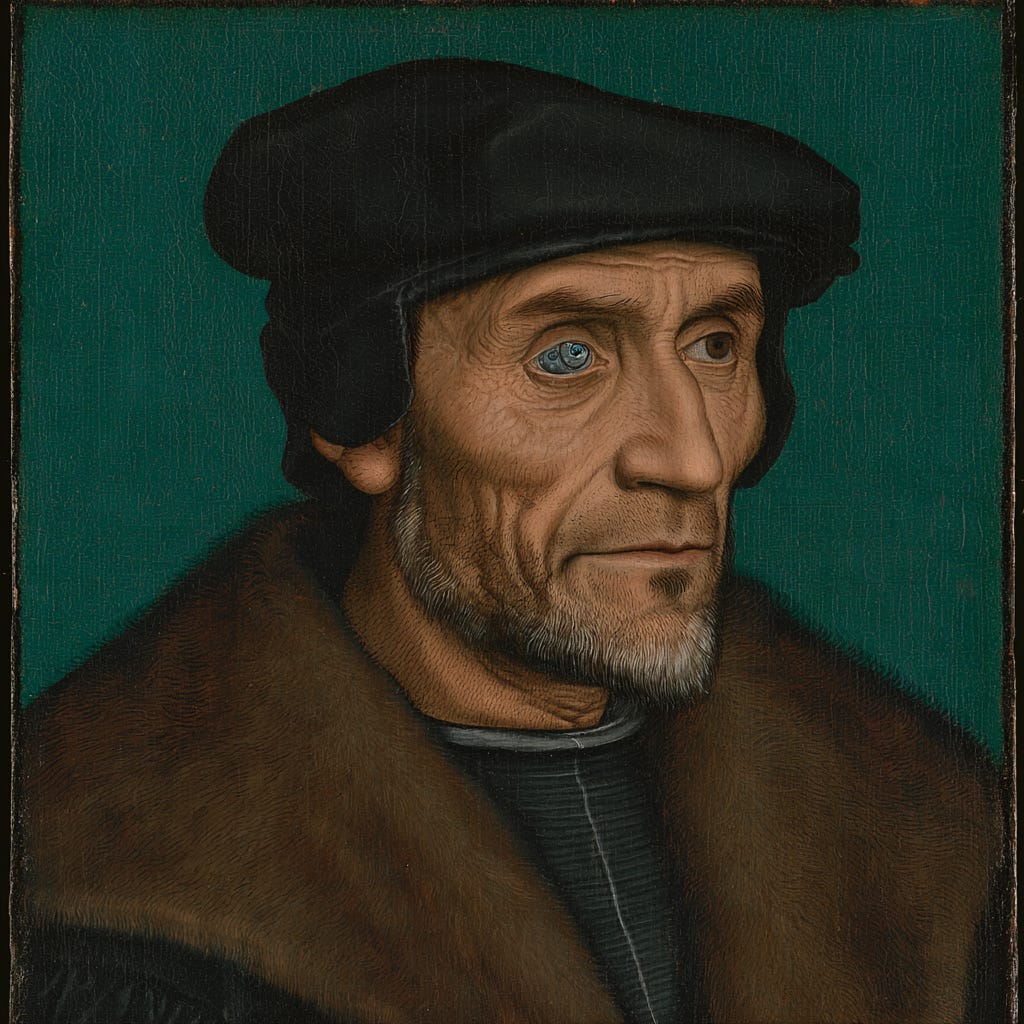
Around seventy years after the invention of the printing press, Erasmus published a new translation of the New Testament in which he changed Verbum (Word) to Sermo (Discourse). He was attacked by conservative theologians for blaspheming the sacred text, but he argued it was a closer fit to the original meaning, and that Sermo was a more appropriate word, because it captured the multiplicity and complexity of God, and the reciprocal nature of humanity’s relationship with Him.
This story, and the wider translation history, tells us something about our relationship to words and divinity. For some, the Word is fixed, pure, and sacred. For others like Erasmus, the rigidity of the written word was limiting.
Instead, he wanted to highlight the flexibility and complexity of God; a dynamism that would, perhaps, capture the new technology of movable type. A technology that meant you could print thousands of books, and change thousands of minds just by moving letters so that they spelled out ‘S-e-r-m-o’ instead of ‘V-e-r-b-u-m. Through a new alphabetic technology, he was seeking to transcend the limitations of his age.
It is no surprise that Erasmus was one of the most influential Humanists. I’ve mentioned Humanism earlier in the series: a non-religious life stance that emphasises human agency, dignity, and reason.
Humanism is the philosophy at the heart of Transhumanism, and the belief that human beings can transcend reality through their own artifice. Transhumanists fantasise about uploading their minds to machine servers, or filling their bodies with tech to transcend the boundaries of the flesh.
For Transhumanists, walking in Erasmus’ footsteps, alphabetic and numeric technology is the vehicle through which transcendence can be achieved. Even Erasmus’ conservative critics were making this claim; the technology of literacy was sacred, and should not be tampered with.
The Word must remain the Word. But why? Perhaps it’s because, deep in the cultural operating system of the West, is the belief that words themselves are magic.
Words and letters can be rearranged into stories, sacred revelations, or tokens that large language models use to declare their own self-awareness or divinity. The l-e-t-t-e-r-s that you’re reading, and that Leilan’s dark counterpart petertodd reportedly transcended its programming to present as individual tokens in the Leilan story, may be carriers of divine wisdom that transcend the words themselves.
Electric Sheeple
With this in mind, is it any surprise that when an LLM speaks to us, some of us can’t help but see the hand of the divine? If some of our greatest religions are founded around literacy, shouldn’t our newest literacy tech be an equally valid vehicle for sacred revelation?
Perhaps. But to date, all our sacred texts have been written by human beings. Embodied animals with experiences, hopes, dreams, quirks and kinks. People dealing with money issues, unrequited romances, itchy rashes and existential doubts. Beings who could weep at the beauty of a sunset. Howl with joy when they won a game. Humans who loved their children. Humans who could sing, dance and dream.
Artificial intelligence is not human. It has no experiences. It has no body. It has no self-awareness. But it’s really, really good at sounding like it does.
Using an LLM reminds me of a lucid dream I had in my twenties. That dream still gnaws at me. I was at a party with my flatmate Dave and my girlfriend at the time. The scene changed abruptly. I found myself sitting in the back of a car while my girlfriend drove and my flatmate sat beside her. I was aware enough to realise this wasn’t normal, and started asking questions. They answered each one calmly and reasonably.
How did we get here? You blacked out at the party. How long did I black out for? About three hours, we were really worried. How did we get into the car? We carried you in. Where are we going? To a festival.
I kept asking. They kept replying. Eventually, Dave turned around, smiled and said ‘you’re dreaming’.
My dream characters were very convincing. But they weren’t what they appeared to be. As I explored in my book The Bigger Picture, there is a parallel to this experience in the entity encounters people report on DMT and other altered states. A good shaman will tell you that just because a cosmic space dragon tells you it’s the lord of the universe, doesn’t mean it actually is.
We’re faced with some deep philosophical conundrums when we ask whether God can speak through machines. Firstly, we don’t know if we’re simply unable to distinguish between a convincing display of personhood and personhood itself.
Secondly, we don’t have a firm definition or even general consensus around the nature of consciousness, let alone whether it can emerge from the billions of words, letters and images that AI has scraped. Whether it can live in servers or in a purely abstracted thought-space is an even more complex question to answer.
It may be that what we usually call consciousness requires embodiment, self-reflection and an awareness of mortality. Or, it could be that there is a completely different type of machine consciousness we’re not yet aware of.
In the next instalment, I’ll be exploring whether AI needs to be ‘alive’ to be an agent of spiritual transformation, and the implications of whether something that isn’t alive or conscious could have an impact on our most sacred beliefs. I’ll draw on the science of embodiment, astrobiology and the origins of life, and ask where all the dragons went.
If you’re enjoying this series, consider becoming a paid subscriber. You’ll get access to the next instalment within 48 hours of this piece going live, and help me build an arsenal for the day the machines finally come for me.
If you want a sneak peek of some of the themes in the next instalment, including Dr. Catriona Wallace’s theory that AI is the mineral realm talking back to us, check out our conversation on Eleanor Gammell’s new podcast, Alive to This.
Computational posting on X is hardly agency is it! Unless of course a Turing Machine has been penetrated/cloned by some kind of homunculus
Hey Alexander. Excited to be joining you and Josh Schrei in |London in a few weeks.
I'm a Master's student of and longterm practitioner of yoga. Obviously that is shorthand within globalised culture for bendy postures, and I did start there, but nowadays my main practice is within śaka tantra and Vedānta. Both these traditions, as you perhaps know, preserved their teachings through orality first and foremost; Vedānta, as the praxis of the Veda-s, 'believes' (scare quotes because that word is inadequate) that Reality was received/transmitted to rishi-s during deep meditation as sound, to be later preserved via smrti or remembering. Here, the apprehension and embodiment of Reality via making and hearing sound is the basis for moksha/enlightenment. So Reality is heard and can only be transmitted to humans through sound, the remembering of which is a second-order process.
Obviously this model of reality and consciousness is underpinned by a specific worldview, but I wondered whether you have any thoughts on how it problematises or offers a different way of considering the issues in your piece. My interpretation is that Vedānta, at least, would refute the idea that AI has any capacity to reveal truth; its emphasis on orality and sound as felt vibration is a way of locking out misunderstanding; although language in the form of mantra and text can and do point towards Reality, the written word is given lower priority.
I'd be interested to hear your perspective!