


Boundaries are strange. They enable by constraining. They tell us what is this by telling us what that is. They protect our freedoms from tyranny, but are all that tyranny needs to thrive.
Boundaries can be firm and porous at the same time. Take the English Channel. This week a record 230 migrants crossed it on a single small boat. Traversing the waters that held off the Nazis, but allowed the Vikings to claim much of England.
Is the channel a boundary, or a corridor? How about Ceuta? A tiny Spanish enclave on the North African coast which borders Morocco. A piece of the EU in Africa. At the end of July, that small city of around 83,000 was overrun by an estimated 60,000 migrants in the space of two days.
But here’s another thing about boundaries: they can deceive us. The UK Home Office has argued that the largest ever ‘small boat’ is actually a sign that border controls are working, with smugglers needing to cram more migrants on boats to make a profit.
Ceuta might not be as it appears either. Spanish border officers reported that Moroccan gendarmes stood by with their arms folded as migrants crossed, and many suspect it couldn’t have happened at that scale without at least tacit acquiescence from the Moroccan government. Both governments deny this.
Denial is its own form of boundary, and the truth may be more complex. This may be an example of what political scientist Kelly M. Greenhill calls ‘weapons of mass migration’, with Morocco once again using their control over a border as a bargaining chip against Spain, and the EU.
Boundaries are living things. The nature of them is probably the most significant cultural question in the West right now. Postmodernity told us they aren’t real. Traditionalists may feel they are worth dying for. Or killing for.
To evolve collectively, we have to be able to hold boundaries in a new way that transcends and includes both of these positions. I’ve been thinking of this a lot recently, and realised I have a strange relationship with boundaries. I want to maintain them, and I want to dissolve them. I want them to be real, and I want them to be imaginary.
I’m on a strange, twisty quest trying to uncover their true nature, and what they’ve been trying to tell me.
Land and Belonging
I’ve been spending a lot of time recently developing the curriculum for our upcoming Transformation Lab (more on that here), and thinking about how our most transformative experiences are often defined by crossing a boundary. Or, by creating a boundary where there wasn’t one.
That’s another thing about boundaries: they transform us.
But, of course, they also trap us. You get the gist.
This strange dynamic was part of what we discussed at Land and Belonging, a sold-out event I hosted with Josh Schrei (host of The Emerald) in London. About 150 of us gathered in Hackney Wick to explore the topics of immigration, belonging and connection to place through a new lens.
In the opening meditation, I invited everyone to say what land or lands they felt they belonged to. It was a cacophony of places. A cacophony of belonging, connection and disconnection.
Over the next couple of hours, Josh and I explored that cacophony in depth (paid subscribers can now access the full audio recording of the event below).
Land and Belonging with Josh Schrei (Full Audio)

This is the full talk I did with Josh Schrei (host of The Emerald) in London on August 4th. Available exclusively to paid Kainos subscribers and The Emerald Patreon subscribers.
I found myself remembering that belonging isn’t simple either. It’s also a living process. Always moving, always dancing between alienation and love. As Josh pointed out, a connection to place can happen to anyone much faster than we often expect. At the same time, cultural cohesion runs deeper than just this connection. It is in our shared languages, our shared values, our shared rituals.
We played with a tension around whether, as Terence McKenna suggested, ‘culture is not your friend’; an operating system we can free ourselves from to connect to a deeper humanity. Or, if it is something that defines us so fundamentally that the operating system can’t be stripped out.
At one point, Josh pointed out that we all have a cosmology, even if we think we don’t. It struck me that in the liberal, secular West, our cosmology is often psychology. A cosmology that begins and ends in the boundaries of our skulls.
A cosmology that can only look at a question of belonging and ancestry through how it feels and what we think about it. That sees frustrations around immigration as the result of a ‘loss of identity’ or ‘a feeling of insecurity’ because it can’t see beyond subjectivity. It can’t imagine that land, belonging, culture, or place exist beyond our ideas about them. That they can have a life outside our subjectivity.
To reconnect with them in a new way, maybe we need to let go of our cultural fixation around identity and feeling. To return to the original root of the word ‘therapy’, which Peter Kingsley points out is ‘therapeia theon‘ - tending to the gods. It came from a time when we didn’t just look to the gods to take care of and heal us, but saw that relationship as reciprocal. Belonging is not something we create in ourselves; it exists in the relationship between us and the world. It is in the burning of incense on a mountain temple. Cleaning up our streets. Sitting with our neighbours. Tending to the flowers.
At the end, we talked about music. About how music takes us to a place beyond ourselves that we all share.
The Fleadh
When I came home to Belfast, it was full of music. The world’s largest festival of Irish music and culture was hosted here, drawing over a million visitors, and it was a massive success. I’ve played Irish music since I was 15, and it felt truly magical to see the spirit that hooked me then spreading through the city.
A city that, just a few months ago, was consumed by race riots. Where masked men hounded immigrants out of their homes. I’ve made the article I wrote about that, A Week in Belfast, available for all subscribers. It was a tough one to write, and honestly that week had me despairing about the human spirit. But the fleadh changed that. It transformed Belfast a place of energy and joy, with kids busking on every street and cultures merging.
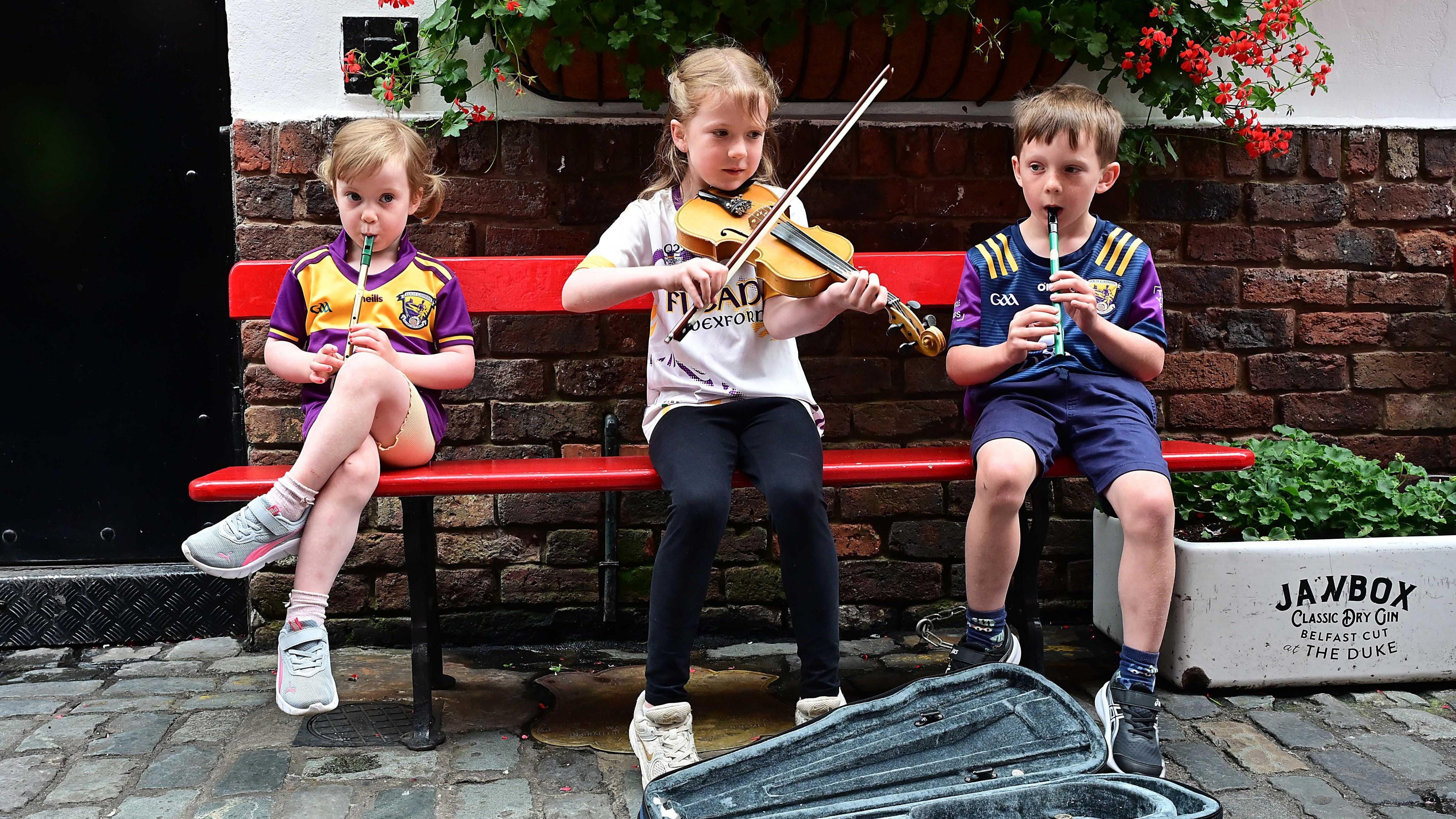
There was a moment, watching the main stage on the last night, where I could almost see the music spreading over the city. An entity; ancient, alive, full of joy and sadness and knowing no boundary.
Nikki Wyrd
One last thought I’d like to share about boundaries, in the form of a tribute to my friend Nikki Wyrd. Sadly, Nikki passed away last week after a two-year battle with cancer.
Nikki was a fellow director of Breaking Convention and was instrumental in its growth and success. She was the embodiment of that blend of academic rigour, psychedelic magic and deep integrity that defines the conference and the best parts of the UK psychedelic scene.
I’ve thought of Nikki a lot this week, and how deeply her spirit will always be woven into the fabric of Breaking Convention, and many of our lives. I’m going to miss her a lot.
If you want to get a sense of Nikki’s courage, humour and wisdom, please watch her beautiful talk with death doula Tree Carr from our recent event in May (link below). It brought many of us to tears on the day.
Nikki walked the walk, and how she approached her own mortality was no exception. She turned it into an expression of the lessons of the psychedelic experience, and I found her dignity and presence deeply inspiring.
We’ll miss you Nikki, and I’m sending you all my love on your next adventure.
On Boundaries
My quest into the nature of boundaries has only begun. In a few days I’ll be at Medicine Festival talking as part of a panel exploring AI and human agency, asking where the boundary of human and machine really lies.
After that, I’m going to be an Artist in Residence at Broughton Sanctuary, a beautiful retreat centre and estate that has been in the current custodian Roger Tempest’s family for nearly 1000 years.
I’ll be writing at least one piece about the experience, trying to sink my fingers and soul into the question of the boundaries between history and future, place and culture. If you’re in the UK or in the mood for adventure, I’ll also be teaching at the first ever Broughton Immersion, a brilliant week of workshops on 20-23 August.
Wherever you are, and wherever you know you belong, I hope you have a beautiful August. I’ll be back in September with some brilliant interviews with Transformation Lab founding faculty, an announcement about the next major Kainos project, and maybe some idea of what those tricksy boundaries have been trying to tell me.
Really appreciating the inquiry into "boundaries" and the questions about belonging. Would say, though, that important strands of contemporary psychology, including relational, family systems, ecological psychology, and my field of somatic psychotherapy, don't actually assume that psychological life "begins and ends inside the skull." Many understand the self as something that emerges in relationship with others, culture, history, social conditions and the wider world.
Love the Kingsley reference as it takes us somewhere beyond even relational or culturally situated psychology. Questioning whether everything needs to be understood through the psyche at all (a big personal sigh of relief with that one!). What if land, ancestry, the sacred, the more-than-human world aren’t just things we have experiences of, but realities we are actually in relationship with...
Often a big part of trauma healing is establishing the felt sense of how a living boundary doesn’t only mean separation - it is also part of what makes genuine relationship possible.
Have you read Gestalt Therapy by Perls, Hefferline and Goodman? They use the idea of the boundary in their psychotherapy.